
📋 Table of Contents
- How to Get Saplings
- Where to Plant a Sapling
- Growth Requirements for All Tree Types
- How to Plant a Tree — Step by Step
- How to Use Bone Meal to Speed Up Growth
- All Tree Types in Minecraft 2026
- How to Grow Giant 2x2 Trees
- Special Trees — Mangrove, Cherry, Azalea, Pale Oak
- Nether and End Trees
- How to Build a Basic Tree Farm
- Why Is My Sapling Not Growing?
- FAQs
How to Get Saplings
Saplings drop when leaves decay naturally after you cut a tree down or when you break leaf blocks manually. When leaves decay or are broken by any tool other than shears, they have a 5% chance of dropping a sapling, except jungle leaves, which have a 2.5% chance.
Breaking leaves with Shears collects the leaf block itself without dropping a sapling. To get saplings from jungle trees specifically, break leaves without Shears since the drop rate is already low and destroying the blocks normally gives the best chance.
Other Ways to Get Saplings
🧑🌾 Villager Trading
Wandering Traders occasionally sell saplings for Emeralds. This is useful for obtaining rare types like Cherry or Pale Oak without traveling to remote island biomes.
🏰 Woodland Mansions
58 dark oak saplings generate naturally in a sapling farm room in Woodland Mansions. 28 dark oak saplings are also found inside a chest in that room.
🗃️ Chest Loot
Various structures including villages, dungeons, and mineshafts contain saplings in their loot chests.
🎮 Creative Mode & Mod APK
Players with access to creative mode or the Minecraft Mod APK can take any sapling type directly from the inventory, without finding or growing them first.
Where to Plant a Sapling
Saplings can grow into trees when placed on all variants of dirt except dirt paths or moss blocks.
Valid soil types for saplings include Dirt, Coarse Dirt, Rooted Dirt, Podzol, Mycelium, Mud, and Moss Blocks. Grass Blocks also work because they are a type of dirt. Dirt Path blocks are the flat path-looking blocks created by using a Shovel on Grass — do not support sapling growth.
Growth Requirements for All Tree Types
Every sapling has three core requirements to grow: Light, Space, and Valid Soil. All three must be met simultaneously.
Light Requirements
The block above the sapling requires a light level of at least 9 for its growth stage to increase. Bone meal can be used to speed up the growth of the sapling, even without sufficient light.
A light level of 9 or above at the sapling block itself is needed for natural growth. A torch placed directly beside the sapling typically provides enough light in most setups. Daylight outdoors always provides sufficient light. Underground farms require torches, glowstone, sea lanterns, or other light sources placed near each sapling.
Space Requirements by Tree Type
Each tree type needs a clear column of space above the sapling to grow. Blocks present in the required column prevent the sapling from growing at all.
| Tree Type | Minimum Space Above | Horizontal Clearance |
|---|---|---|
| Oak | 5 blocks | 3×3 column |
| Birch | 6 blocks | 3×3 column |
| Spruce (single) | 6 blocks | 5×5 column |
| Giant Spruce (2×2) | 14 blocks | 6×6 column |
| Jungle (single) | 5 blocks | 3×3 column |
| Giant Jungle (2×2) | 11 blocks | 6×6 column |
| Acacia | 6 blocks | 5×5 column |
| Dark Oak (2×2 only) | 7 blocks | 3×3 (Java) / 6×6 (Bedrock) |
| Pale Oak (2×2 only) | 7 blocks | 3×3 (Java) / 6×6 (Bedrock) |
| Cherry | 8 blocks | 5×5 column |
| Mangrove | 5 blocks | 3×3 column |
How to Plant a Tree — Step by Step
Get a Sapling
Get a sapling by breaking leaf blocks from any existing tree. Leaves break quickly with bare hands or any tool except Shears.
Choose Valid Soil
Choose a location with valid soil. Dirt, Grass, Podzol, Mycelium, Coarse Dirt, Rooted Dirt, Mud, or Moss Blocks all work.
Check Space Above
Make sure there is enough clear space above the planting location for the tree type you want to grow. Use the space table above as a reference.
Plant by Platform
Select the sapling in your hotbar and place it on the soil block using the platform-specific control:
| Platform | How to Plant Sapling |
|---|---|
| Java Edition PC | Right Mouse Button |
| Bedrock Edition PC | Right Mouse Button |
| Mobile Android and iOS | Tap the soil block |
| Xbox | Left Trigger |
| PlayStation | L2 |
| Nintendo Switch | ZL |
Wait for Growth
The sapling appears on the soil block. It will grow on its own over time as long as the light and space conditions are met.
Optionally Apply Bone Meal
Optionally apply Bone Meal to speed up growth immediately.
How to Use Bone Meal to Speed Up Growth
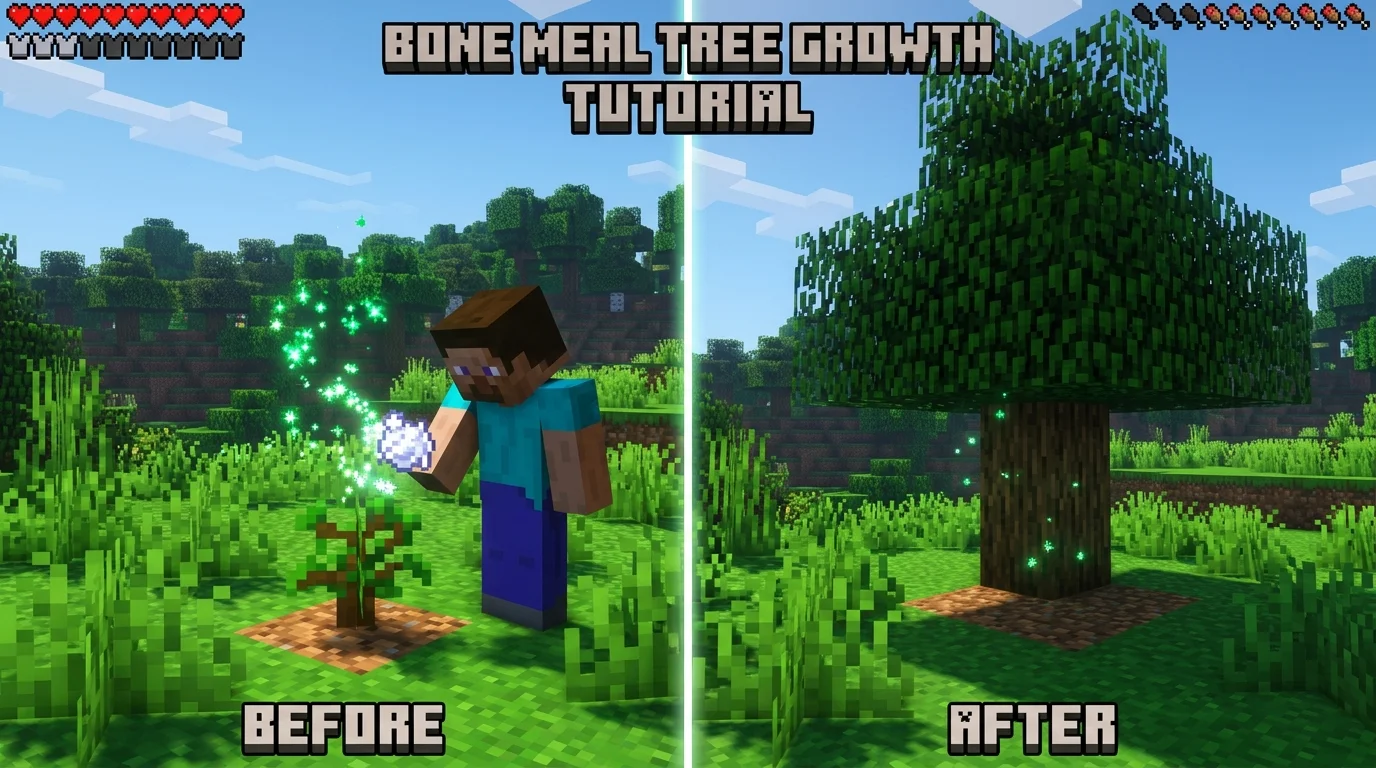
To speed up the growing process with Bone Meal, select Bone Meal in your hotbar and then use the Bone Meal on your sapling. It may take a few applications before you see your tree shoot up to a full-grown tree.
Bone Meal does not guarantee instant growth on the first application. It forces a growth attempt. If the attempt succeeds, the tree grows immediately. If not, the Bone Meal is still consumed, and you must apply another. Most saplings need 1 to 3 applications to grow, depending on the tree type and current conditions.
How to Get Bone Meal
Craft Bone Meal from a single Bone in any crafting grid, producing 3 Bone Meal. Bones drop from Skeletons and Strays when killed. A Composter also produces Bone Meal by filling it with food items, plants, or saplings. Placing a sapling into a Composter has a 30% chance of raising the compost level by 1. A stack of saplings yields an average of 2.74 Bone Meal. Combining a Composter with excess saplings from a tree farm creates a self-sustaining Bone Meal supply.
Applying Bone Meal to 2×2 Trees
For giant trees requiring four saplings in a 2×2 arrangement, Bone Meal can be applied to any one of the four saplings. Bone Meal can be used on any of the saplings to make the tree grow more quickly. All four saplings grow together as one giant tree when the conditions are met.
All Tree Types in Minecraft 2026
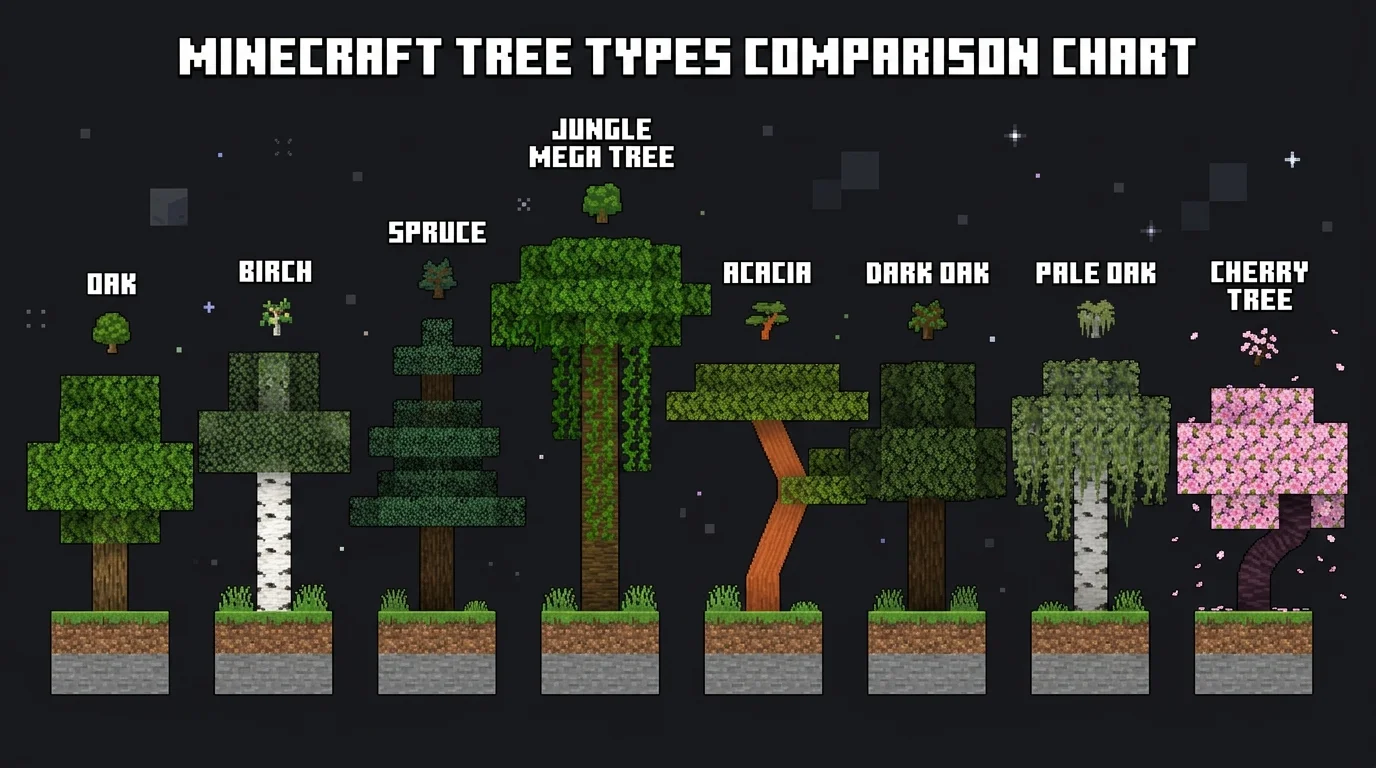
🌳 Oak
Oak is the most common tree and the default early-game wood source. Found in plains, forests, and most non-extreme biomes. Needs 5 blocks of vertical clearance and a 3×3 column. Grows from a single sapling. Oak leaves have a 5% sapling drop rate. Oak trees sometimes grow with an apple hanging from their leaves.
🪵 Birch
Birch has a distinctive white bark and is found in birch forests and mixed forests. Needs 6 blocks of clearance. Birch wood has a clean, light aesthetic popular in interior building. Grows from a single sapling with the same soil and light requirements as Oak.
🌲 Spruce
Spruce is the primary wood of cold biomes including taiga and snowy tundra. Single spruce saplings need 6 blocks of clearance. Four saplings in a 2×2 formation grow into a Giant Spruce requiring 14 blocks of clearance. Spruce grows in the distinctive tall narrow shape recognizable from taiga biomes.
🌴 Jungle
Jungle trees are among the tallest in the game. Single saplings need 5 blocks of clearance and grow into medium-sized trees. Four saplings in a 2×2 formation grow into Mega Jungle Trees, some of the largest structures in the game, reaching up to 30 blocks tall and averaging 96 logs per tree. These trees average around 96 wood, about 1.5 stacks, and some can exceed 2 stacks. Jungle sapling drop rate from leaves is only 2.5%, so collect from large trees to build your supply.
🌵 Acacia
Acacia is found in savanna biomes and has a distinctive grey bark and wide flat canopy. It needs 6 blocks of clearance and a 5×5 column. Acacia logs have a unique diagonal grain texture that makes them popular for modern and rustic building styles.
🌑 Dark Oak
Dark Oak requires exactly 4 saplings in a 2×2 square configuration. Dark oaks have thick 2×2 trunks and require 4 saplings placed in the same configuration to be grown by a player. They grow in dark forests and always generate dirt blocks under their trunks. The thick trunk and large irregular branches make Dark Oak the fastest wood-per-tree yield among common types.
👻 Pale Oak
Pale Oak is a newer addition found in the Pale Garden biome. Like Dark Oak, it requires 4 saplings in a 2×2 formation. In order to grow a 2×2 tree, four saplings must be placed adjacent to each other in a square. Pale Oak naturally generates with Pale Hanging Moss under the leafy crown, giving it a distinctive ghostly appearance different from any other tree in the game.
🌸 Cherry
Cherry trees are found in Cherry Grove biomes with their distinctive pink leaf canopy and curved branches. They have a unique petal-falling particle effect that no other tree produces. A Cherry tree requires a 5×5 area of unobstructed space 8 blocks above its sapling. Cherry logs are bright pink-toned and the most visually distinctive wood type in the current game.
🍂 Poplar — Upcoming Third Drop 2026
Poplars are found in dappled forests. They can generate or grow with red, orange, or yellow leaves. Shelf mushrooms sometimes generate on the trunk. The Poplar is confirmed for the Third Drop of 2026 and will be the first tree with autumn color variation, able to grow leaves in red, orange, or yellow depending on generation conditions. This is not yet available in the current stable release 1.26.40.26.
How to Grow Giant 2×2 Trees
Giant trees require four saplings of the same type placed in a 2×2 square configuration. This works for Spruce, Jungle, Dark Oak, and Pale Oak.
Choose a Large Open Area
Choose a flat open area with significantly more vertical clearance than a single tree would need. Giant Spruce needs 14 blocks minimum. Giant Jungle needs 11 blocks minimum. Dark Oak and Pale Oak need 7 blocks minimum.
Place Four Saplings in 2×2
Place four saplings of the same type in a 2×2 square, with no gaps between them and no diagonal spacing.
Clear All Obstructions
Make sure there are no blocks adjacent, even diagonally, to the north-western side up to the final height of the tree trunk. Even a torch or a single leaf block in the wrong position prevents the giant form from growing.
Apply Bone Meal
Apply Bone Meal to any one of the four saplings to trigger growth. All four grow together as one massive tree instantly.
Harvest the Giant Tree
Harvest the giant tree using an axe. Giant Jungle trees are the largest single structure to harvest in the game and take significant time even with a Netherite axe. Plan for an extended harvest by bringing extra food and bringing a way back to the ground after climbing.
Special Trees — Mangrove, Cherry, Azalea, Pale Oak
🌿 Mangrove
Mangrove trees grow from Propagules rather than saplings. Propagules hang from existing Mangrove leaves and can be broken off to collect. Mangrove is a rare tree, but it can be planted underwater, and they create Mangrove Roots which can be used as extra fuel. Using Bone Meal on the leaves also produces a guaranteed Propagule.
Mangrove Propagules must be placed on Mud, waterlogged Mud, or Mangrove Roots. They grow downward into the water before rising upward, creating the distinctive stilt root structure. Never drain water near immature Mangroves since this permanently halts growth.
🌸 Cherry
Cherry trees have the most demanding space requirement of any single-sapling tree at 8 blocks of vertical clearance and a 5×5 column. Cherry trees have distinct pink leaves and curved branches with a unique petal-falling particle effect. Cherry wood is the most colorful wood type in the game and works particularly well in Japanese-inspired and fantasy building styles.
🌺 Azalea
Azalea trees grow differently from every other tree in the game. Apply Bone Meal to an Azalea Bush or Flowering Azalea Bush on the ground to grow an Azalea tree from it. Azalea trees can be manually grown by applying Bone Meal to an Azalea or Flowering Azalea block. The trunk is made of Oak Logs rather than a unique wood type. Azalea trees only generate naturally above Lush Caves and serve as a surface indicator that a Lush Cave lies below.
👻 Pale Oak
Pale Oak grows only in 2×2 configurations like Dark Oak. It is found exclusively in the Pale Garden biome, a rare white-leafed forest with a distinctive dim atmosphere. The Pale Hanging Moss that appears under Pale Oak canopies is a unique block not found on any other tree type.
Nether and End Trees — Huge Fungi
The Nether does not have traditional trees but has Huge Fungi that serve the same role as a wood source. Huge Fungi can be grown from Crimson or Warped Fungus, placed on Crimson Nylium or Warped Nylium. To grow into a Huge Fungus, the original fungus must be planted on the matching type of Nylium, and then Bone Meal applied to it.
🔴 Crimson Huge Fungi
Crimson Fungus on Crimson Nylium grows into a Huge Crimson Fungus, producing Crimson Stems used as the Nether's red wood type.
🔵 Warped Huge Fungi
Warped Fungus on Warped Nylium grows into a Huge Warped Fungus producing Warped Stems used as the Nether's teal wood type.
How to Build a Basic Tree Farm
A tree farm is a controlled planting area that produces a continuous supply of logs and saplings. Tree farming is the process of planting a large number of saplings and waiting for them to grow into trees. This can be repeated indefinitely, yielding a regular supply of logs without the hassle of covering large areas of terrain, making wood a renewable resource.
Simple Row Farm for Oak or Birch
Dig Spaced Planting Holes
Dig a row of holes 1 block deep. Space each hole 4 blocks apart from the next to give each tree room to grow without leaves blocking neighbor growth.
Plant Saplings
Plant one sapling in each hole.
Add Lighting
Place a torch in the center of the row to ensure light level 9 at all sapling positions, allowing growth day and night.
Grow and Harvest
Wait for trees to grow or apply Bone Meal for immediate growth. Harvest each tree by breaking all log blocks from the bottom up. Collect fallen saplings quickly before they despawn after 5 minutes.
Replant Immediately
Replant immediately using collected saplings. A 3×3 grid of trees growing will usually produce enough saplings to replace itself in the long term.
Tree Farm with Composter
Add a Composter beside your collection chest. Drop excess saplings into it to generate Bone Meal. Feed the Bone Meal back to new saplings to grow them instantly. This closed loop means your tree farm never requires any outside input once the initial saplings are planted.
Automated Tree Farm with the Crafter Block
For a fully automated setup (similar to an automated pumpkin farm), combine a Dispenser filled with Bone Meal connected to a Redstone clock, a hopper system that collects saplings and deposits them into planting positions, and a Crafter block that converts harvested logs into Planks automatically. The full automated tree farm requires significant initial setup but runs indefinitely without player interaction once built.
Why Is My Sapling Not Growing? — Common Problems
💡 Not Enough Light
The most common reason. Check the light level at the sapling block itself. A level below 9 prevents natural growth. Place a torch directly beside the sapling. Bone Meal bypasses this requirement and forces growth even in complete darkness.
📏 Not Enough Space Above
A block is present in the growth column. This can be a floating block, the underside of a structure, a torch, a water block, or even a leaf from a nearby tree. Check the entire column required for your specific tree type and remove any obstructions.
🪨 Wrong Soil Type
Dirt Path blocks look like dirt but do not support sapling growth. Replace with a regular Dirt or Grass Block.
👻 Dark Oak or Pale Oak Planted Alone
Dark Oak and Pale Oak cannot grow from a single sapling. They require exactly 4 saplings in a 2×2 square. A single Dark Oak or Pale Oak sapling never grows regardless of how much Bone Meal is applied.
🌿 Saplings Too Close Together
If multiple saplings are planted next to each other, each one grows as long as the leaves from the other grown saplings do not block too much of the sunlight. Dense planting can cause some saplings to fail once neighbors grow and their canopies shade lower positions. Space single saplings at least 3 to 4 blocks apart.
🚶 Player Too Far Away
Saplings can grow only if a player is within a certain radius, even in loaded chunks. A sapling planted in a distant chunk where no player is present does not grow even if all other conditions are met. Stay near your tree farm or use a design where player activity naturally keeps you close.
🌺 Bone Meal Not Working on Azalea
Bone Meal on an Azalea Bush only grows the tree form when applied to the Azalea Bush block on the ground. Applying it to the leaves of an already-formed Azalea tree does not trigger further growth. The correct target is the lowest bush block at ground level.
Frequently Asked Questions (FAQ)
Conclusion
Planting trees in Minecraft is the single most fundamental skill in the game. Every crafting recipe, every fuel source, every early shelter, and every later build project traces back to wood. Understanding the growth requirements for all tree types, knowing how to use Bone Meal effectively, and building even a basic tree farm transforms wood from a resource you gather into a resource you produce on demand.
The most important things to remember are simple. Valid soil, light level 9, sufficient vertical clearance, and the right sapling count for each species. Dark Oak and Pale Oak always need 4 saplings in a square. Bone Meal bypasses light requirements and speeds up any tree type. Space saplings at least 3 to 4 blocks apart in farms to prevent canopy interference.
Players on the Minecraft Mod APK have every sapling type and unlimited Bone Meal available from the start, making tree farms optional rather than essential. For players building in vanilla survival, a well-designed tree farm set up in the first few days of a world removes wood scarcity permanently. For the complete tree mechanics reference, including every sapling space requirement and biome compatibility detail, the official Minecraft Wiki tree page is the most thorough and current source available.