
How to Make Rails in Minecraft
You craft rails in Minecraft with iron ingots and a stick on a crafting table, 6 iron ingots plus 1 stick gives you 16 standard rails in one go. Powered, detector, and activator rails use the same 3 by 3 grid with different materials swapped in, gold for powered rails, redstone components for the other 2. All 4 types work the same way in Java Edition and Bedrock Edition, only the crafting menu layout differs between them.
Table of Contents
What are rails in Minecraft and what do they do?
Rails are track blocks that carry minecarts across a set path, and Minecraft has 4 types, each with a distinct job. Standard rails just carry the cart. Powered rails speed a cart up or slow it down depending on redstone power. Detector rails send a signal when a cart rolls over them (great for automated builds like a pumpkin farm or water elevator system). Activator rails trigger something on the cart itself, like ejecting a rider or triggering TNT explosives.
Standard rails
Standard rails are the base track type, and they're the only ones that curve and turn automatically. Place them next to each other, and they connect on their own, curving into corners or sloping up a 1-block rise without extra input from you.
Powered rails
Powered rails accelerate a minecart when they're receiving redstone power, and slow it to a stop when they're not. They can't curve, only straight sections, so any turn in your track needs to switch back to standard rails for that section.
Detector rails
Detector rails send out a redstone signal the moment a minecart rolls over them, and that signal can drive a comparator, a piston, a door, whatever you wire it to. They're commonly used to trigger a powered rail boost automatically or open a station door as a cart arrives.
Activator rails
Activator rails don't move carts faster or slower, they trigger cart-specific behavior instead. A player-holding cart gets ejected, a hopper cart dumps its items, and a TNT cart gets primed. Like powered rails, they're straight-only and can't curve.
| Rail type | Function | Curves? | Needs redstone? |
|---|---|---|---|
| Standard rail | Carries the minecart | Yes | No |
| Powered rail | Speeds up or brakes the cart | No | Yes, to boost |
| Detector rail | Sends a signal when a cart passes | No | No (outputs it) |
| Activator rail | Ejects riders, dumps hopper carts, primes TNT | No | Yes, to activate |
How do you make rails in Minecraft?
All 4 rail types are crafted at a crafting table using a 3 by 3 grid, no furnace or smithing table involved. The core materials are iron for standard, detector, and activator rails, and gold for powered rails.
What materials are needed to craft standard rails?
Standard rails need 6 iron ingots and 1 stick per crafting batch. That single batch yields 16 rails, more than double what powered, detector, or activator rails give you per craft, since standard rails see the most use across any track.
How do you craft standard rails?
Open a crafting table and place iron ingots in the left and right columns across all 3 rows 6 ingots total, then put a stick in the center of the middle row. That pattern yields 16 rails in one craft, enough to lay 16 blocks of straight or curved track before you need to craft again.
How do you craft powered rails?
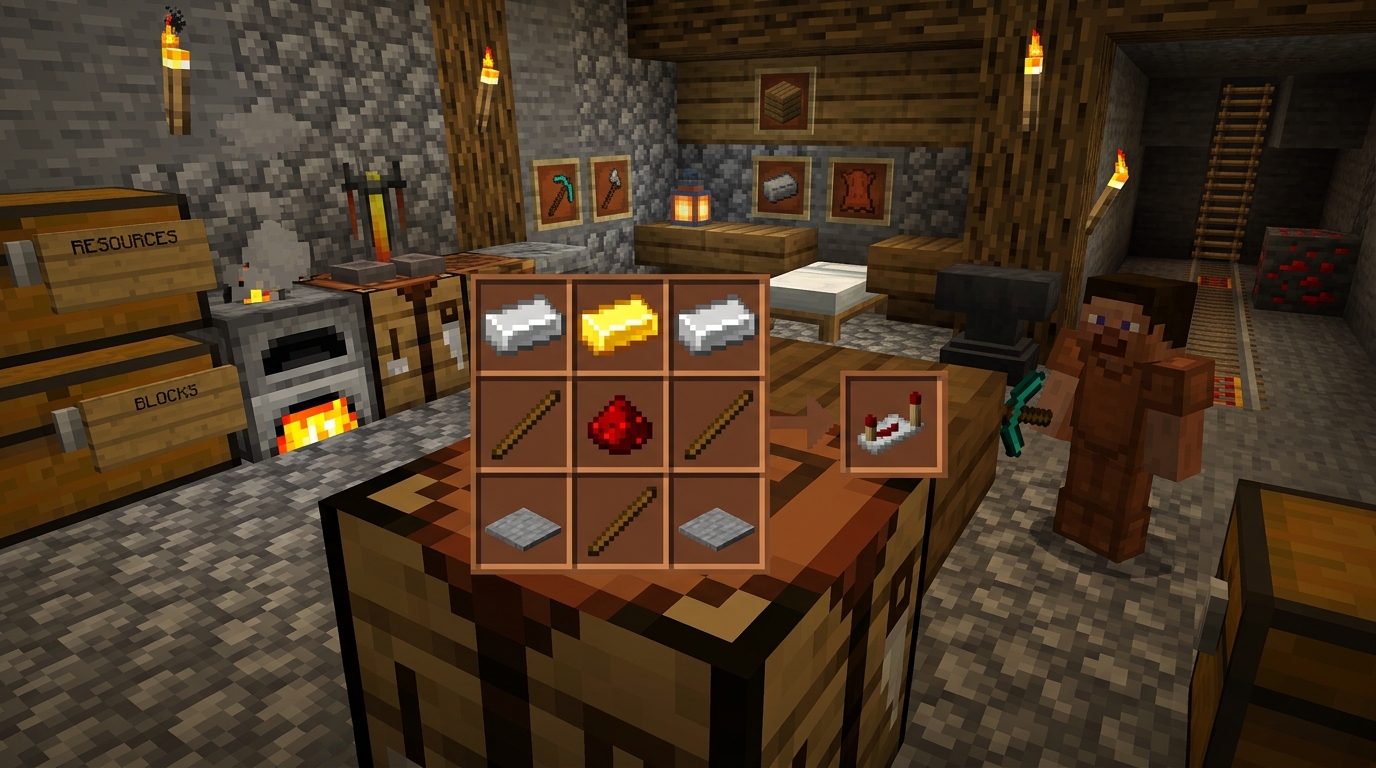
Powered rail recipe: place gold ingots down the left and right columns across all 3 rows (6 gold ingots total), a stick in the center of the top and middle rows, and 1 redstone dust in the center of the bottom row. This yields 6 powered rails per craft, fewer than standard rails since you'll usually only need a handful spaced along a longer stretch of track.
Detector rails follow a similar pattern with iron instead of gold: 6 iron ingots down the sides, a stone pressure plate in the center of the middle row, and redstone dust in the center of the bottom row, yielding 6 detector rails. Activator rails swap the pressure plate and redstone dust for a redstone torch in the center row and sticks in the center of the top and bottom rows, again with 6 iron ingots down the sides, yielding 6 activator rails per craft.
How do you use rails in Minecraft?
Placing a rail is a single click on a solid block with the rail item selected, and the game handles orientation automatically in most cases. Riding one just means getting into a minecart on top of the track, no extra input needed once you're moving.
How do you place rails correctly?
Right-click (or the equivalent placement action on console and mobile) a solid block with rails selected, and the rail auto-orients to connect with any adjacent rail already placed. If you're placing the first rail in an area with nothing nearby, it defaults to a straight north-south line until something else forces a curve.
Can rails be placed diagonally in Minecraft?
No single rail block can sit at a true diagonal angle; rails only run in straight lines or right-angle curves. You can fake a diagonal by stair-stepping standard rails 1 block over and 1 block up or down in a repeating zigzag, which reads as diagonal from a distance even though each segment is orthogonal.
Can rails be placed on any block?
Rails need a solid, full-size block underneath them, so most normal terrain and building blocks work fine. They won't sit on non-full blocks like fences, slabs, or glass panes, and they can't be placed directly over air, water, or lava without solid support first.
How do powered rails work?
A powered rail only boosts a cart while it's actively receiving redstone power from a nearby lever, redstone torch, redstone block, or signal running through redstone dust. Without power, a powered rail acts as a brake instead, slowing any cart that crosses it, which makes it useful for stopping carts at a station without extra mechanics.
How do detector and activator rails work together?
A detector rail can trigger an activator rail further down the track by feeding its signal into redstone dust or a redstone torch positioned near the activator rail. This combination is the standard setup for an automatic unloading station: the cart rolls over the detector rail, which fires the activator rail, and the activator ejects the rider or dumps the hopper cart's contents without you touching anything.
Why won't my rails connect in Minecraft?
Rails usually fail to connect for 1 of 3 reasons: a gap larger than 1 block between placed rails, a height change of more than 1 block between 2 rail segments, or the rail being placed while sneaking, which locks its orientation instead of letting it auto-connect. Rails only bridge a 1 block gap automatically; anything wider needs a filled-in path first. If you're building a slope, check that each rise is exactly 1 block, not 2, since rails can't ramp up more than that in a single step.
How can you build an efficient Minecraft rail system?
An efficient rail system comes down to 2 things: enough powered rails to maintain speed, and a layout that avoids sharp unpowered curves that bleed momentum. Get those 2 right and a minecart line moves at a consistent pace across long distances without you pushing it manually.
How should you space powered rails?
On flat ground, spacing 1 powered rail roughly every 25 to 38 blocks is usually enough to keep a cart moving at full speed, since friction from standard rails only slows a cart gradually. Going uphill needs powered rails much closer together, sometimes every other block, since gravity fights the cart's momentum the whole way up. I'd confirm exact spacing against your current game version before publishing a hard number, since minecart friction behavior has had minor tuning across updates.
How can you avoid common rail-building mistakes?
The most common mistake is running long unpowered stretches uphill and wondering why the cart stalls out partway. The 2nd is placing powered rails without a power source next to them, which turns them into unintended brakes instead of boosters. Check every powered rail against a nearby lever, torch, or redstone line before assuming it's doing its job.
How can you make minecart travel more efficient?
Keep curves gentle and place them on standard rails only, since a sharp curve on top of a fast straight run kills speed hard. Chain-loading multiple carts back to back (as a train rather than 1 cart at a time) also cuts down the number of trips you need for hauling items or players across a long line.
Rails in Java Edition vs Bedrock Edition
Rail crafting, placement, and function are identical across Java Edition and Bedrock Edition (as well as mobile builds on Android and iOS), the only differences are in the crafting menu itself. Bedrock's inventory includes a recipe book with rail recipes pre-listed, useful if you don't want to memorize the grid pattern, while Java's crafting table needs the pattern placed manually unless you're using the recipe book there too, which both editions actually support now. Minecart physics and powered rail spacing behave the same in both, so a rail system built on Java transfers directly to a Bedrock world without redesigning anything.
Rails and the Create mod
The Create mod's train system is a separate mechanic from vanilla rails and isn't compatible with them. Create tracks use their own track blocks and a rotational power system driven by waterwheels, windmills, and other in-mod machinery, rather than redstone and minecarts. If a guide or video shows a "rail" build using components like andesite alloys or mechanical presses, that's Create-specific content (explore our Minecraft Mods collection for modding options), not the vanilla system covered here, and it needs Forge or Fabric plus the Create mod installed before any of it works. I'd check Create's own wiki or changelog for exact current recipes before treating any Create track recipe as fixed, since mod recipes shift between mod versions more often than vanilla ones do.
Frequently asked questions
Place 6 iron ingots down the left and right columns of a crafting table's 3 by 3 grid and 1 stick in the center of the middle row, which yields 16 standard rails per craft.
A detector rail sends a redstone signal out when a cart crosses it, while an activator rail receives redstone power to trigger cart-specific effects like ejecting a rider or dumping a hopper cart.
Yes. Breaking a placed rail with any tool (or by hand) drops it as an item you can pick up and place again, no durability loss or destruction involved.
Yes, crafting, placement, and rail mechanics all match between the 2 editions, only the crafting interface itself looks different.