
How to make a piston in Minecraft
A piston in Minecraft is a block you craft from 3 wooden planks, 4 cobblestone, 1 iron ingot, and 1 redstone dust, placed in a crafting table. Once built, it pushes any block in front of it when it receives a redstone signal, and pulls back when the signal stops. That single mechanic is the base of nearly every redstone door, trap, and farm in the game.
Table of Contents
- What is a piston in Minecraft?
- How do pistons work in Minecraft?
- What can you use a piston for in Minecraft?
- Piston vs. sticky piston: what's the difference?
- What materials do you need to craft a piston?
- How to craft a piston in Minecraft
- How to make a sticky piston in Minecraft
- How to use a piston in Minecraft
- How to make a piston door in Minecraft
- What can you build with pistons in Minecraft?
- How do pistons work with other redstone components?
- What is the difference between pistons in Minecraft editions?
- Why isn't my piston working in Minecraft?
- FAQs
What is a piston in Minecraft?
A piston is a machine block that extends and retracts an arm to push blocks around when powered by redstone. It doesn't move on its own. Something has to trigger it: a lever, a button, a redstone torch, a repeater, or an observer.
There are 2 types in the game: the regular piston and the sticky piston. Both push blocks forward. Only the sticky piston can pull a block back with it when it retracts.
How do pistons work in Minecraft?
A piston reads redstone power the same way a door or a dispenser does. No signal, no movement. The moment a signal reaches the piston, its face extends 1 block into whatever is directly in front of it, pushing that block (and, if there's a connected row, up to 11 more blocks behind it) forward by 1 space.
Cut the signal and a regular piston's arm retracts, but the block it pushed stays where it landed. A sticky piston retracts and drags that same block back with it, because of the slime-coated face.
Pistons can't push everything. Blocks like obsidian, bedrock, ender chests, and most tile entities such as chests and furnaces will block the piston instead of moving. If a piston tries to push more than 12 blocks in a line, or hits an unmovable block, nothing happens at all.
What can you use a piston for in Minecraft?
Pistons show up in almost every practical redstone build:
- Automatic and hidden doors
- Traps that drop players or mobs into a pit
- Crop and cactus farms that harvest on a timer
- Elevators that move the player up or down
- Flying machines that carry blocks or the player across open space
If a build needs something to move, a piston is usually part of the answer.
Piston vs. sticky piston: what's the difference?
The build process is almost identical: craft a regular piston first, then add 1 slime ball to turn it into a sticky piston. The difference is entirely in what happens when the signal cuts off.
| Feature | Piston | Sticky piston |
|---|---|---|
| Pushes blocks forward | Yes | Yes |
| Pulls block back on retract | No | Yes |
| Extra crafting step | None | Add 1 slime ball |
| Common use | One-way pushes, traps, piston doors that don't need to reset a block | Doors, farms, and any build where a block needs to return |
Pick a regular piston when you only need to push something once. Pick a sticky piston when the build needs to reset itself, which covers most doors and farms.
What materials do you need to craft a piston?
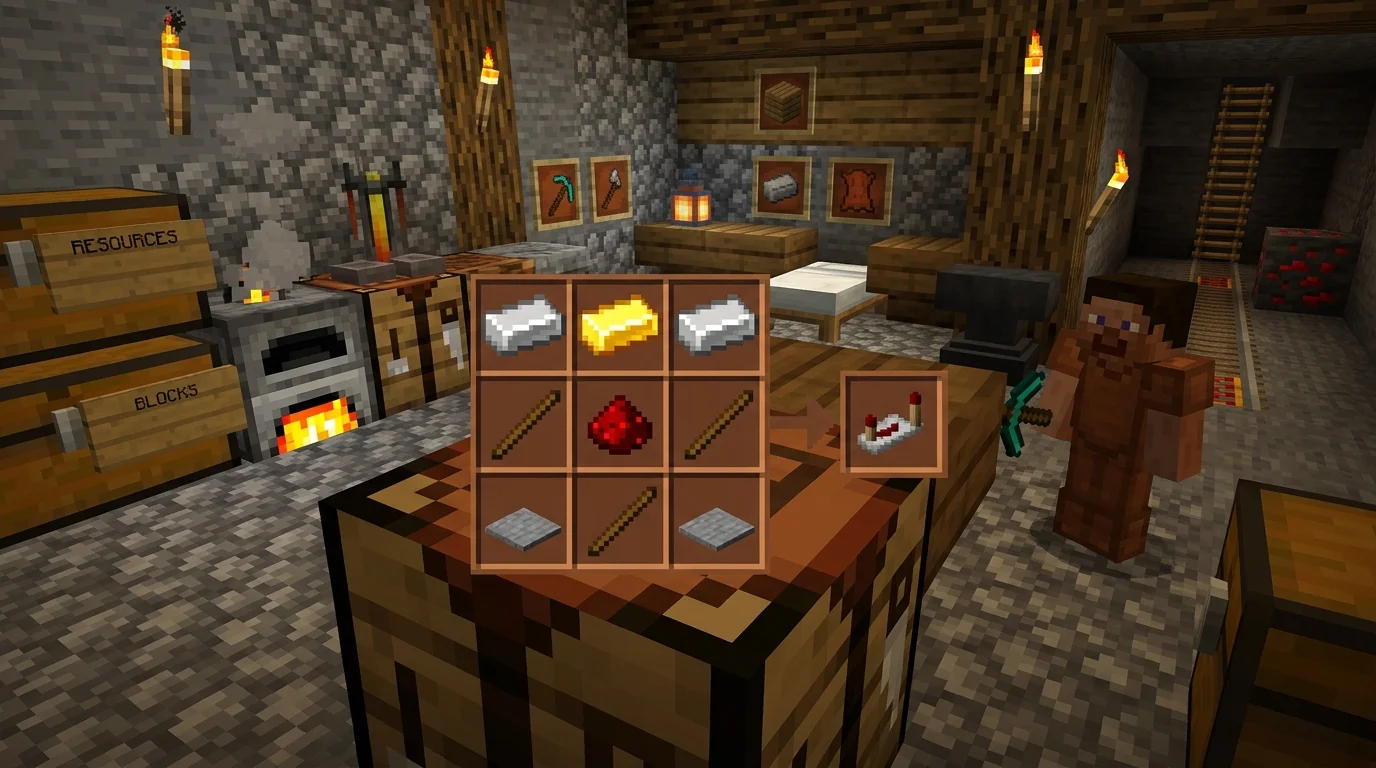
You need 3 wooden planks, 4 cobblestone, 1 iron ingot, and 1 redstone dust. That's 9 items total, filling every slot in a crafting table except the very center, which stays empty.
Piston crafting recipe and required materials
Place the items in this exact 3x3 layout:
- Top row: wooden plank, wooden plank, wooden plank
- Middle row: cobblestone, iron ingot, cobblestone
- Bottom row: cobblestone, redstone dust, cobblestone
Any wood type works. Oak, spruce, birch, jungle, acacia, dark oak, mangrove, cherry, bamboo planks, and crimson or warped planks from the Nether all count as wooden planks for this recipe.
Where to find cobblestone, wooden planks, iron ingots, and redstone dust
Cobblestone comes from mining regular stone with any pickaxe. Wooden planks come from crafting logs, 1 log makes 4 planks.
Iron ingots need a furnace. Mine raw iron ore with a stone pickaxe or better, then smelt it with coal, charcoal, or another fuel source. 1 raw iron plus fuel gives 1 iron ingot.
Redstone dust drops from mining redstone ore, which generates below Y level 16 in most versions and needs an iron pickaxe or better to break. A single redstone ore block usually drops 4 to 5 dust, more with Fortune.
How to craft a piston in Minecraft
How to make a piston in Minecraft survival mode
- Mine at least 4 cobblestone and gather 3 wooden planks.
- Smelt raw iron into 1 iron ingot in a furnace.
- Mine redstone ore below Y16 for at least 1 redstone dust.
- Open a crafting table and arrange the 9 items in the layout above.
- Take the piston out of the result slot.
How to craft a piston using the crafting table
A piston can only be crafted at a 3x3 crafting table. The 2x2 grid in the inventory screen is too small to fit the recipe, since it uses all 8 outer slots.
Open the crafting table, place the materials exactly as shown in the recipe layout, and the piston appears in the output slot the moment the pattern is correct.
How to make a piston in Minecraft Bedrock Edition
The recipe is identical to Java: 3 wooden planks, 4 cobblestone, 1 iron ingot, 1 redstone dust, arranged the same way. Bedrock's crafting table interface looks slightly different and lets you drag items directly into the grid on mobile and console, but the item placement and quantities don't change.
How to make a piston in Minecraft Java Edition
Java Edition uses the same 9-item recipe. The only practical difference from Bedrock is the crafting table UI itself, plus recipe book shortcuts that highlight the correct pattern once you have the ingredients in your inventory.
How to make a sticky piston in Minecraft
A sticky piston is a regular piston with 1 slime ball added on top. Craft the piston first, then combine it with the slime ball at a crafting table to get the sticky version.
Sticky piston recipe and required materials
Place 1 piston in any crafting slot and 1 slime ball directly above, below, or beside it. The exact position doesn't matter as long as both items are touching in the grid pattern the game expects: 1 slime ball on top of 1 piston.
You need everything from the regular piston recipe, plus a slime ball on top of that.
How to craft a sticky piston
- Craft or obtain a regular piston.
- Get 1 slime ball, either from a slime mob or a wandering trader.
- Open a crafting table and place the slime ball above the piston.
- Collect the sticky piston from the output slot.
Can you make a sticky piston without slime?
No. There's no crafting substitute for a slime ball, and honey blocks won't work in the recipe even though they behave like slime blocks when a piston pushes them. If you're out of slime balls, you still need to get one before you can craft a sticky piston.
Slime balls come from 3 sources: killing slime mobs (found in swamp biomes at night or in slime chunks below Y40), buying them from a wandering trader when that trade is available, or waiting for a baby panda to sneeze, since adult pandas occasionally sneeze out a slime ball. Fishing has a small chance of pulling one up as junk loot too.
How to use a piston in Minecraft
A piston does nothing until it gets redstone power. Place it facing the block you want to move, run a power source to it, and it extends. Cut the power, and it retracts.
How to power a piston with redstone
A piston accepts power from any redstone source touching it or the block it's attached to: a lever, a button, a pressure plate, redstone dust running into it, a redstone torch, or a signal from a repeater or observer. The piston's back and sides all accept power, so you can wire it from whichever direction fits the build.
How to make a piston extend and retract
Extend: apply any redstone signal to the piston. Retract: remove that signal. A lever gives manual control, since flipping it on extends the piston and flipping it off retracts it. A button gives a short pulse, useful for a piston that should extend once and come back on its own after the button's timer runs out.
How to use redstone dust, repeaters, and redstone torches with pistons
Redstone dust carries a signal up to 15 blocks before it needs a repeater to boost it further. A repeater also adds delay, in increments of 1 redstone tick (0.1 seconds) up to 4 ticks, which is useful for timing multiple pistons in sequence.
A repeater's own recipe is 3 stone, 2 redstone torches, and 1 redstone dust, crafted in a row: stone, torch, stone on top, torch and dust in the middle-ish pattern the recipe book shows. Placed in line with a piston, a repeater lets you delay exactly when that piston fires relative to everything else in the circuit.
A redstone torch gives constant power to anything it touches, and inverts a signal when placed against a powered block, which makes it useful for pistons that need to stay extended until something else turns on.
How to use observers with pistons
An observer detects when the block directly in front of it changes, and sends a single-tick redstone pulse out its back. That makes it one of the most reliable ways to trigger a piston, since it reacts to block updates instead of needing a separate switch.
To craft an observer, use 6 cobblestone, 2 redstone dust, and 1 nether quartz in a crafting table, with quartz in the center of the front row and cobblestone filling most of the outer ring. Point the observer's face at the piston (or at whatever block change should trigger it), and connect its back to the piston's power input.
Observers are the backbone of most modern piston flying machines and compact farms, because they fire the instant a block updates automatically, with no delay circuit needed.
How to make a piston door in Minecraft
A piston door uses 1 or more pistons to move blocks out of a doorway when triggered, then move them back to close it. The simplest version uses a single sticky piston. Larger doors chain several pistons together to open a full 2x2 or 3x3 space.
How to craft a simple piston door
- Dig a 1-wide, 2-tall doorway into a wall.
- Place a sticky piston facing into the doorway from one side, so its face sits where the door block should be.
- Place a movable block, like wool or a slab, in front of the piston face.
- Wire a button or lever on both sides of the wall to the piston.
- Power the piston to pull the block back and open the space, cut the power to close it again.
How to build a secret door with pistons
A secret door hides the trigger, not just the door. Common methods include a hidden button behind a painting, a pressure plate under a rug, or a note block or lever disguised inside a bookshelf. The piston mechanism itself stays the same, only the switch is concealed.
For a door that leaves no visible seam when closed, build it flush with the surrounding wall using matching blocks, and route the redstone wiring behind the wall or under the floor so nothing is visible from the room.
How to make a piston door without slime
Without a sticky piston, the pushed block won't retract on its own, so you need 2 regular pistons facing each other: one to push the door block open, and a second one on the opposite side to push it back closed. This uses more redstone wiring than a sticky piston version but avoids needing a slime ball entirely.
How to make a hidden entrance with sticky pistons
A hidden entrance usually combines a piston door with camouflage: a bookshelf, a fireplace, a section of wall that looks unbroken until triggered. Because sticky pistons pull the disguise block back into place automatically, they're the standard choice for any entrance that needs to look seamless when closed.
What can you build with pistons in Minecraft?
Automatic doors and secret entrances
Beyond a basic door, pistons can open gates, drawbridges, and multi-block entrances that retract an entire wall section at once. Larger builds usually chain pistons together with redstone dust or repeaters so every piston fires within the same tick.
Piston traps and redstone mechanisms
Pistons can drop a floor out from under a player, close off an exit, or push mobs into a pit or lava. Timing usually comes from a redstone clock (a repeater loop or an observer loop) feeding into the piston.
Automatic farms with pistons
Piston-based farms harvest crops, cactus, or sugar cane by pushing a block that breaks the crop, or by pushing the crop itself into a collection area. Cactus and sugar cane farms are especially common because both break instantly when pushed sideways.
Piston flying machines
A flying machine uses a slime block or honey block attached to a piston and an observer, arranged so the whole structure moves itself forward, up, or down one block at a time. These are used to carry TNT, sand, or other blocks across long distances without a player controlling each move manually.
How do pistons work with other redstone components?
How to use an observer with a piston
Covered above: point the observer at a block, wire its back into the piston, and any change in front of the observer fires the piston with a single-tick pulse.
How to use a repeater to control a piston
A repeater placed between a power source and a piston adds a delay of 1 to 4 redstone ticks, which is how most multi-piston builds stay in sync even when the pistons aren't wired at equal distances from the trigger.
How to use a dispenser with a piston
A dispenser doesn't power a piston directly, but the two are often combined: a piston pushes a block to trigger a dispenser's detection, or a dispenser fires an item that lands on a pressure plate wired to a piston. A dispenser is crafted from 7 cobblestone, 1 bow, and 1 redstone dust, with the bow in the center slot.
What is the difference between pistons in Minecraft editions?
Pistons in Minecraft Java Edition
Java pistons follow the standard recipe and behavior described above, with the most precise redstone tick timing of any version, which matters for advanced flying machines and compact farms built by the technical Minecraft community.
Pistons in Minecraft Bedrock Edition
Bedrock pistons use the same recipe and largely the same behavior, though some redstone timing quirks differ slightly from Java due to a different underlying tick system. Most builds designed for one edition still work on the other with little to no adjustment.
Pistons in Minecraft Pocket Edition
Pocket Edition was merged into Bedrock Edition years ago, so mobile Minecraft today runs on Bedrock code. A piston built on a phone or tablet behaves the same as one built on Xbox or Windows.
Pistons on Xbox, PlayStation, and Nintendo Switch
All 3 consoles run Bedrock Edition, so the piston recipe, crafting steps, and mechanics match what's described above for Bedrock, with the same touch or controller-based crafting menu depending on the platform.
Pistons in Minecraft Education Edition
Education Edition is also built on Bedrock code, so pistons craft and behave the same way, with the addition of the education-focused chemistry and coding tools layered on top that don't change redstone mechanics.
Why isn't my piston working in Minecraft?
Why isn't my piston moving?
Check that a power source is actually reaching the piston and not just running past it. Redstone dust only carries power to blocks it's directly adjacent to or running into, not blocks it merely passes near.
Why won't my sticky piston pull a block back?
Confirm it's actually a sticky piston and not a regular one; they look almost identical at a glance. Also check that the block being pulled isn't 1 of the types pistons can't move, and that nothing is physically blocking the space the block needs to return to.
Why isn't my redstone signal reaching the piston?
Redstone dust has a 15-block range before the signal drops to 0, and it can't cross certain gaps or travel through solid blocks without a repeater boosting it along the way. Add a repeater every 15 blocks (or sooner) if the piston is far from the original power source.
FAQs
Combine 3 wooden planks, 4 cobblestone, 1 iron ingot, and 1 redstone dust in a crafting table, following the recipe layout above.
The same way as Java: 3 wooden planks, 4 cobblestone, 1 iron ingot, and 1 redstone dust, in the same 3x3 pattern.
No. A slime ball is the only way to craft a sticky piston, though you can get one from a slime mob, a wandering trader, or an occasional panda sneeze instead of only relying on the Swamp.
Place a sticky piston facing a doorway, put a movable block in front of it, and wire a switch to power and unpower the piston, which pushes the block out to close the gap and pulls it back to open it.
Use 2 regular pistons facing opposite directions, one to push the door open and one to push it shut, since neither piston needs to retract a block on its own.
Build a normal piston door, then hide the trigger behind a painting, under a pressure plate rug, or inside a lever disguised as part of the wall, so the mechanism isn't visible from the room.